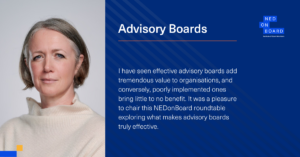
In this blog post, we explain what advisory boards are and promote their role and impact in an organisation.
Key takeaways
- An advisory board is a group of independent experts who provide strategic advice and specialist expertise to an organisation.
- Advisory boards have no governance authority, decision-making powers or legal responsibilities.
- Organisations often establish advisory boards to access expertise, challenge management thinking and support growth initiatives.
- Advisory boards can be particularly valuable for entrepreneurs, scale-ups, charities and organisations facing complex strategic or technical challenges.
- A successful advisory board requires a clearly defined purpose, carefully selected members and well-defined expectations.
What is an advisory board?
📝 Definition: An advisory board is a group of experienced individuals who provide independent advice, expertise and external perspectives to an organisation’s leadership team and, where applicable, its board of directors.
Unlike a board of directors, an advisory board does not govern the organisation. Instead, it serves as a source of guidance, challenge and specialist knowledge to help leaders make better-informed decisions.
Advisory boards are commonly used by startups, private companies, family businesses, charities and organisations across sectors and of varied size undergoing growth, transformation or significant change.
Advisory board definition
An advisory board is a non-governing body that provides strategic guidance and subject matter expertise to an organisation without having formal decision-making authority or legal responsibility for the organisation.
Advisory board members are advisors, not directors. Their role is to support and challenge management, rather than oversee the organisation’s governance.
Advisory board vs board of directors
One of the most common questions organisations ask is: What is the difference between an advisory board and a board of directors?
The distinction is important.
A board of directors is responsible for governance, strategic oversight and protecting the long-term interests of the organisation and its stakeholders. Directors have legal duties and responsibilities under applicable legislation, including the Companies Act 2006 in the UK.
An advisory board provides advice but does not govern the organisation.
| Topic | Advisory Board | Board of Directors |
|---|---|---|
| Governance authority | No | Yes |
| Decision-making powers | No | Yes |
| Fiduciary duties | No | Yes |
| Legal responsibilities | No | Yes |
| Companies Act 2006 obligations | No | Yes |
| Strategic guidance | Yes | Yes |
| Independent challenge | Yes | Yes |
| Accountability for decisions | No | Yes |
Organisations should therefore view advisory boards as a complement to management and governance structures, not a substitute for them.
Why establish an advisory board?
The effectiveness of an advisory board begins with a clear answer to two questions:
- Why are we establishing an advisory board?
- What do we expect advisory board members to contribute?
Without clear objectives, advisory boards often fail to deliver meaningful value.
When established for the right reasons, advisory boards can strengthen strategic decision-making, provide access to specialist expertise and improve organisational performance.
Who should consider establishing an advisory board?
👉 Entrepreneurs and founders
Entrepreneurs frequently face strategic decisions without having access to experienced advisors inside their organisation.
An advisory board can provide:
- Independent challenge
- Mentorship and guidance
- Access to networks and relationships
- Introductions to customers, partners and investors
- Expertise that would otherwise be unavailable or unaffordable
For founders, an advisory board often serves as a trusted sounding board while allowing them to retain control of the business.

👉 Organisations pursuing strategic growth
Advisory boards can be highly valuable when organisations are pursuing major strategic initiatives such as:
- Entering new markets
- Raising capital
- Acquiring another business
- International expansion
- Business transformation
In these situations, organisations benefit from advisors who have successfully navigated similar challenges before.
👉 Boards seeking specialist expertise
Boards and executive teams increasingly face complex and highly technical issues.
Examples include:
- Artificial intelligence
- Digital transformation
- Climate and sustainability
- Equity, diversity and inclusion
Rather than appointing additional directors, organisations may establish an advisory board comprising subject matter experts who can provide specialist insight when required.
What are the benefits of an advisory board?
✅ Access to expertise
Advisory board members bring experience, knowledge and perspectives that may not exist internally.
✅ Independent challenge
Effective advisory boards challenge assumptions and help management identify blind spots, risks and opportunities.
✅ Enhanced strategic decision-making
Advisors can provide practical insights based on their own experiences, helping organisations avoid common mistakes.
✅ Stronger networks
Many advisors bring valuable industry relationships and introductions that can accelerate organisational growth.
✅ Increased credibility
Well-regarded advisors can strengthen an organisation’s reputation with investors, customers, partners and stakeholders.
✅ Flexible access to talent
Organisations gain access to high-quality expertise without expanding the formal board of directors.
How to set up an effective advisory board
Step 1: Define the purpose
Clearly identify the strategic challenge, opportunity or expertise gap the advisory board will address.
Step 2: Identify required skills
Conduct a skills assessment and determine what expertise is needed to support the organisation’s objectives.
Step 3: Recruit the right advisors
Look beyond impressive job titles. The most effective advisors bring relevant experience, constructive challenge and a genuine commitment to helping the organisation succeed.
Step 4: Establish terms of reference
Step 5: Focus on strategic discussions
Advisory board meetings should focus on future opportunities, risks and strategic priorities rather than operational updates.
Step 6: Review effectiveness regularly
As organisational priorities evolve, so should the composition and focus of the advisory board.
How are advisory board members compensated?
Compensation arrangements vary depending on the organisation’s size, maturity and expectations. And financial resouces!
Common approaches include:
- Reimbursement of expenses
- Honorariums
- Meeting fees
- Annual retainers
- Equity participation, particularly in startups and scale-ups
In many early-stage organisations and charities, advisory board positions may be voluntary. In larger organisations, advisory board members are often compensated at a lower level than non-executive directors because they do not carry governance responsibilities or legal liabilities.
💡Recommendations for organisations
If your organisation is considering establishing an advisory board:
- Define a clear purpose and desired outcomes.
- Recruit advisors with relevant expertise and diverse perspectives.
- Clarify expectations from the outset.
- Focus meetings on strategic priorities.
- Review effectiveness regularly.
- Ensure there is a clear distinction between advice and governance.
The most effective advisory boards create value by providing expertise, challenge and perspective while leaving decision-making authority with management and the board of directors.
Conclusion
An advisory board can be a powerful mechanism for strengthening strategic decision-making, accessing specialist expertise and supporting organisational growth.
Whether supporting entrepreneurs, advising on technical matters or helping organisations navigate major strategic initiatives, advisory boards provide valuable external perspectives without adding governance complexity.
However, success depends on having a clearly defined purpose, the right mix of expertise and a strong understanding of the distinction between advisory and governance responsibilities.
For organisations seeking to strengthen leadership, improve board effectiveness and access experienced independent perspectives, an advisory board can be a highly effective solution.
Frequently Asked Questions
What is an advisory board?
An advisory board is a group of independent experts who provide strategic advice, expertise and guidance to an organisation without having governance authority or legal responsibilities.
What does an advisory board do?
An advisory board provides advice, specialist knowledge, external perspectives and constructive challenge to support better decision-making.
What is the difference between an advisory board and a board of directors?
A board of directors governs the organisation and has legal responsibilities. An advisory board provides advice but has no decision-making authority or legal duties.
Are advisory board members legally responsible for company decisions?
No. Advisory board members are not company directors and do not carry the legal responsibilities associated with directorship.
Should advisory board members be paid?
Many organisations compensate advisory board members through meeting fees, retainers, honorariums or equity. Others, particularly charities and early-stage ventures, may engage advisors on a voluntary basis.
How many members should an advisory board have?
Most advisory boards operate effectively with between 3 and 6 members, although the optimal size depends on the organisation’s objectives and required expertise.
How often should an advisory board meet?
Many advisory boards meet quarterly, although meeting frequency should reflect the organisation’s needs and strategic priorities.
Can startups establish advisory boards?
Yes. Advisory boards are particularly common in startups and scale-ups seeking expertise, mentorship, credibility and access to networks.
Can charities have advisory boards?
Yes. Charities may establish advisory boards to access specialist expertise, strengthen stakeholder engagement and support strategic initiatives.
When should an organisation establish an advisory board?
An advisory board is often most valuable when an organisation is growing, entering new markets, pursuing a major strategic initiative or facing challenges that require specialist expertise.
The article was edited in June 2026.
Written by Elise Perraud, Chief Operations Officer at NEDonBoard, non-executive director, charity trustee and committee chair.