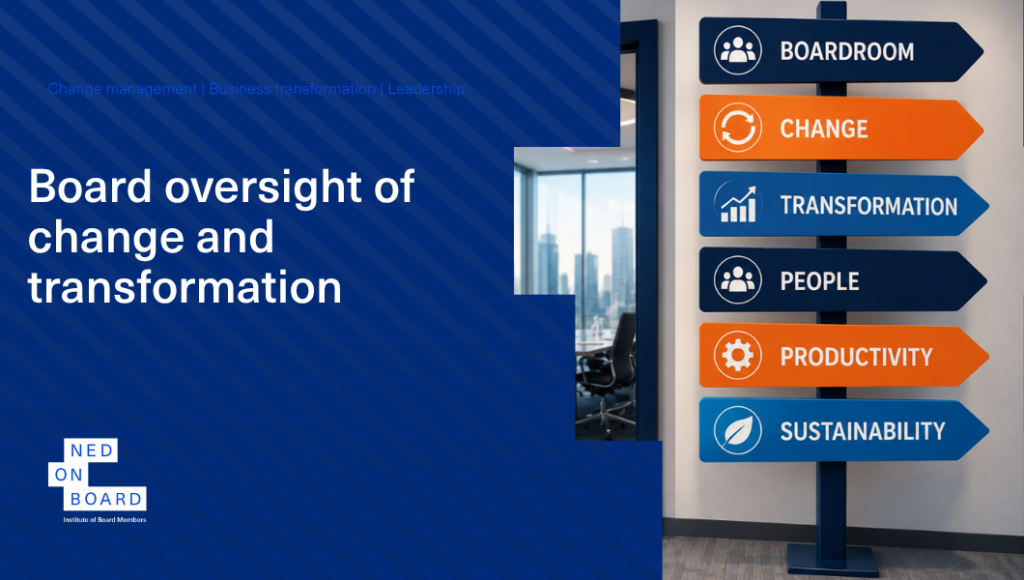
Transformation is one of the defining challenges facing boards today. Whether driven by technology, regulation, productivity pressures, sustainability priorities, or changing stakeholder expectations, organisations across sectors are under pressure to evolve quickly while maintaining effective governance and long-term resilience.
In this article, NEDonBoard member and board advisor Thomas Harrison explores how NEDs can help organisations navigate uncertainty, maintain momentum, and deliver meaningful change.
Key take-aways
- Transformation is a board-level priority.
- Boards increasingly seek NEDs with hands-on transformation and change leadership experience.
- NEDs help boards maintain clarity, momentum, and long-term focus during periods of disruption.
- Transformation programmes often fail due to fragmented priorities, poor communication, and lack of organisational alignment.
- Organisations that fail to adapt risk losing competitiveness, relevance, and long-term viability.
- Public sector organisations face many of the same transformation pressures as private sector businesses.
- Agility, innovation, and adaptive leadership are boardroom capabilities.
Member insight
John Chambers, former CEO of Cisco, once warned: “At least 40% of all businesses will die in the next ten years if they don’t figure out how to change their entire company to accommodate new technologies.” Public sector organisations face the same transformation challenge because government priorities around net zero, digital inclusion, productivity, and public service reform cannot be delivered without modernising operating models and accelerating change.
Jeff Bezos expressed the same truth differently: “The only sustainable advantage you can have over others is agility.” Transformation is the price of relevance, resilience, and long‑term growth and value.
Across every sector, the forces driving this transformation imperative are accelerating: the need to deliver more with less; intensifying competition from digitally native and innovation‑led organisations; tightening regulatory expectations; the urgency of net zero; and shifting societal demands around transparency, ethics, and purpose. Organisations that fail to adapt will become irrelevant.
This is precisely why boards seek non‑executive directors with lived experience of leading transformation in industry.
📝 Definition: In a board and governance context, transformation refers to significant organisational change designed to improve long-term performance, resilience, competitiveness, or public value. This may include digital transformation, operating model redesign, cultural change, restructuring, or sustainability initiatives.
Boards are changing what they look for
Evidence from multiple governance studies back this up. A 2024 BDO and Norman Broadbent survey of 200 board members found that boards now prioritise NEDs who can challenge the status quo, bring strategic insight, and help organisations navigate uncertainty, not simply provide governance assurance. The top value NEDs add, according to respondents, is an independent perspective that avoids groupthink and challenges established assumptions, a hallmark of disruptive and entrepreneurial thinkers.
📝 Definition: Groupthink refers to a situation where boards or leadership teams prioritise consensus and harmony over constructive challenge, resulting in weak scrutiny, limited debate, and poor strategic decision-making.
The Institute of Directors’ 2025 NEDs Reimagined Commission reached a similar conclusion, arguing that boards must “rewire” themselves for a more volatile environment. It calls for NEDs who are bold, curious, strategically engaged, and capable of operating in an “uncertain, changing, and unpredictable climate.” Crucially, the report urges boards to be less conservative in their recruitment and seek directors with the mindset and experience to drive adaptive, future‑focused stewardship.
As disruption accelerates, boards increasingly seek NEDs with transformation, data, and innovation expertise i.e., individuals who have led digital adoption, reshaped operating models, or delivered complex change in regulated environments. While traditionally many NEDs were retired or part-time executives, there is now a growing demand for NEDs who are still active senior executives or have recent, hands-on industry experience. These business leaders are now among the most in‑demand appointments, particularly in the public sector and among SMEs who have the potential to scale up and grow.
Where experienced transformation NEDs add irreplaceable value
1️⃣ Clarity and communication
Transformation fails when it is poorly understood. Boards often underestimate how much organisational energy is lost when the narrative is unclear, inconsistent, or overly technical. NEDs who have led transformation at scale know how to cut through complexity and articulate a compelling, human‑centred vision and ambition that resonates from the boardroom to the everyday staff on the frontline.
This is not a communications exercise, rather a strategic one. A clear narrative aligns investment, accelerates decision‑making, and builds confidence. Transformation NEDs understand how to shape that narrative and ensure it is reinforced consistently across the organisation.
2️⃣ Confidence, momentum, and cadence
One of the most underrated contributions a NED can make is the gift of confidence to the executive team, to the board, and to the wider company. Transformation is inherently destabilising by its very nature because it introduces ambiguity, challenges established power structures and demands sustained energy whilst staff juggle the daily grind of business-as-usual demands.
📝 Definition: Change fatigue occurs when employees and stakeholders become overwhelmed by continuous organisational change, often leading to disengagement, resistance, reduced productivity, and slower execution.
NEDs who have lived through this know that momentum is everything. They understand that the moment an organisation creates a “Plan B,” people will retreat to it out of convenience and to de risk failure. Their role is to hold the line, maintain pace, and help the board stay focused when turbulence inevitably arrives. Boards increasingly recognise this. The BDO-Norman Broadbent research found that strategic thinking and the ability to challenge constructively are now among the most valued NED attributes, qualities strongly associated with leaders who have delivered transformation under pressure.
3️⃣ Programme architecture: One vision, not many competing priorities
One of the most common failure modes in transformation is fragmentation i.e., multiple change projects competing for budget, attention, and executive bandwidth. Without a coherent programme architecture, organisations drift into change fatigue and lose sight of the strategic objective.
📝 Definition: Programme architecture refers to the governance structure, sequencing, prioritisation, and coordination of transformation initiatives to ensure all change activities support a single strategic vision.
NEDs with transformation experience know how to package change into an integrated programme, protect investment from business‑as‑usual pressures, and ensure the board’s headspace remains focused on the long‑term vision rather than short‑term firefighting.
Why this matters: transform or decline
Companies that fail to transform do not survive. Chambers’ 40% prediction was not an exaggeration: it was a reflection of the accelerating pace of disruption. Organisations that cling to legacy models, outdated processes, or slow decision‑making cycles will be overtaken by more agile competitors.
Boards know this. That is why they are increasingly seeking NEDs who are:
- Disruptive: willing to challenge assumptions and push for new thinking.
- Entrepreneurial: comfortable with ambiguity, experimentation, and calculated risk.
- Experienced in transformation: leaders who have delivered change in real‑world conditions.
Transformation‑literate NEDs are becoming essential to organisational survival, and to the public sector’s ability to deliver on government priorities.
FAQs
Why are boards looking for transformation experience in NEDs?
Boards are operating in an environment shaped by technological disruption, regulatory pressure, economic uncertainty, and changing stakeholder expectations. As a result, organisations value NEDs who have practical experience leading change and transformation initiatives.
What is a transformation-focused non-executive director?
A transformation-focused NED is a board member who brings direct experience of leading organisational change, such as digital transformation, restructuring, scaling operations, technology modernisation, cultural change, or operational improvement.
How can NEDs support organisational transformation?
NEDs can support transformation by providing strategic oversight, constructive challenge, governance discipline, stakeholder perspective, and practical insight from previous transformation experience. They also help boards maintain focus, momentum, and accountability.
Why do transformation programmes fail?
Transformation initiatives commonly fail due to fragmented priorities, poor communication, cultural resistance, inadequate leadership alignment, lack of strategic clarity, insufficient governance oversight, or weak execution capability.
For more insights, please visit the resources hub: